


Table of Contents
- Introduction
- Green Building Materials
- Energy-Efficient Designs
- Waste Reduction Techniques
- Smart Building Technologies
- Circular Construction
- Certification Standards
- Case Studies
- Conclusion
As sustainability becomes a driving force in the construction industry, contractors, designers, and developers are adopting forward-thinking practices to build greener, more efficient structures. Incorporating principles of environmental stewardship into general construction projects is not only essential for protecting natural resources but also for creating long-lasting benefits such as lower utility costs, healthier indoor environments, and enhanced property values. As client and regulatory expectations for climate-conscious building intensify, companies embracing sustainable methods are better positioned for long-term success. This guide outlines sustainable construction practices that positively impact environmental and community resilience. It emphasizes innovative materials, waste reduction, and smart design, encouraging developers and builders to adopt eco-friendly strategies that align with modern efficiency standards. By referencing global case studies and certifications, it demonstrates how to strike a balance between short-term costs and long-term benefits.
Green Building Materials
One foundational element of sustainable construction is the selection of green building materials. By opting for renewable resources like bamboo, builders can reduce deforestation and promote rapid regrowth cycles. Recycled steel and low-impact concrete are other excellent options, leveraging waste streams and reducing the use of virgin materials. These choices not only shrink a project’s carbon footprint but also tend to offer superior durability, resulting in structures that withstand the test of time. Adopting regionally-sourced or salvaged materials further enhances sustainability by minimizing emissions associated with transportation and manufacturing.
Energy-Efficient Designs
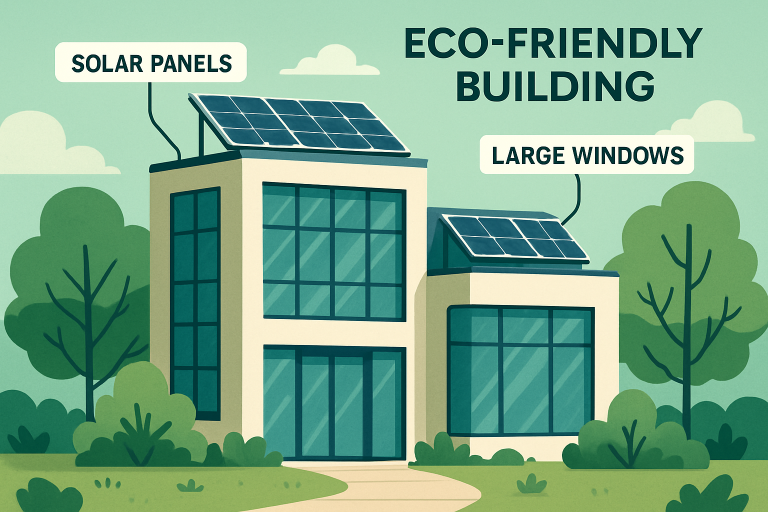
Energy-efficient design principles are a linchpin of modern green buildings. Passive strategies, such as optimized site orientation, daylighting, high-performance windows, and high-quality insulation, help regulate indoor temperatures naturally, reducing the need for mechanical heating and cooling. By integrating renewable energy technologies—think solar panels or geothermal heating—buildings can achieve net-zero or even positive energy statuses, producing more energy than they consume. These methods not only shrink operational costs but also bolster long-term resilience against the volatility of energy prices. The U.S. Department of Energy emphasizes the importance of energy-efficient designs in reducing long-term emissions and costs in the built environment.
Waste Reduction Techniques
Reducing construction waste is crucial for minimizing a project’s environmental impact. Prefabrication of building components enables precision cuts and factory-controlled assemblies, thereby minimizing material waste and on-site debris. When deconstruction is prioritized over traditional demolition, reusable elements like windows, flooring, and fixtures can be salvaged for future use. The rise of 3D printing in construction also enables the production of custom components with remarkable accuracy, resulting in significantly less waste. Digital design tools such as Building Information Modeling (BIM) provide detailed visualizations, helping teams identify inefficiencies and prevent errors before ground is broken.
Smart Building Technologies
Digital transformation is revolutionizing building sustainability through the use of intelligent systems. The integration of IoT (Internet of Things) enables real-time tracking of energy consumption and system performance, allowing for immediate adjustments to maximize efficiency. Advanced sensors can control lighting, HVAC, and water usage based on occupancy and environmental conditions, resulting in significant cost and energy savings throughout a building’s lifecycle. Predictive maintenance, powered by data analytics, ensures equipment runs optimally, reducing both energy waste and unexpected repair costs.
Circular Construction
Circular construction goes beyond the reduction, reuse, and recycling model by actively designing buildings for flexibility and eventual disassembly. This future-focused approach enables materials and modules to be easily separated for reuse or recycling at the end of a building’s life, thereby extending the resource value and minimizing landfill waste. Modular construction—where complete units are built off-site and assembled on location—further increases the ease of deconstruction and future upgrades.
Certification Standards
Compliance with recognized green building standards ensures that projects not only meet regulatory requirements but also embody true industry best practices. The National Green Building Standard (NGBS) provides a credible, uniform benchmark for residential green building, with over 100,000 certified units to date. For commercial and institutional projects, LEED certification remains the most prominent guide, with the newest LEED v5 update putting significant emphasis on decarbonization and ongoing performance improvements. These certifications help builders attract eco-conscious clients and win incentives while advancing broader environmental progress.
Case Studies
Iowa City Public Works Facility
The completion of the Iowa City Public Works Facility in 2019 illustrates how sustainable design can achieve both operational excellence and environmental gains. Consolidating several departments into one efficient space, the 88,000-square-foot facility leverages renewable materials, robust insulation, and advanced waste management to lower ongoing emissions. Its recognition by the AIA Committee on the Environment underscores the growing expectation for municipal projects to lead in sustainability.
Tasmanian House Initiative
Australia’s Tasmanian House project showcases an approach to mass-market green housing. Since its launch in 2020, it has produced affordable, replicable prototypes—like the Tasmanian House 2—built for ease of construction by a single owner-builder using primarily local materials. Drawing from historical architectural styles, these homes minimize synthetic elements, demonstrating that sustainable housing can be both accessible and contextually appropriate.
Conclusion
Forward-thinking, sustainable construction practices are becoming an industry requirement rather than a niche option. Builders who employ eco-friendly materials, energy-efficient designs, and smart building technologies while targeting recognized certifications are well-positioned for long-term success. These strategies not only reduce environmental impact and operating costs but also provide healthier living spaces and more resilient investments. As technology and innovation continue to evolve, sustainable construction is poised to redefine the future of our built environment.
 Benedict Cumberbatch